 Storytella
What Is AI Character Consistency? A Filmmaker's Plain-English Guide
The plain-English explanation of the one feature that separates a real AI film from a sequence of disconnected clips — and how filmmakers actually pull it off.
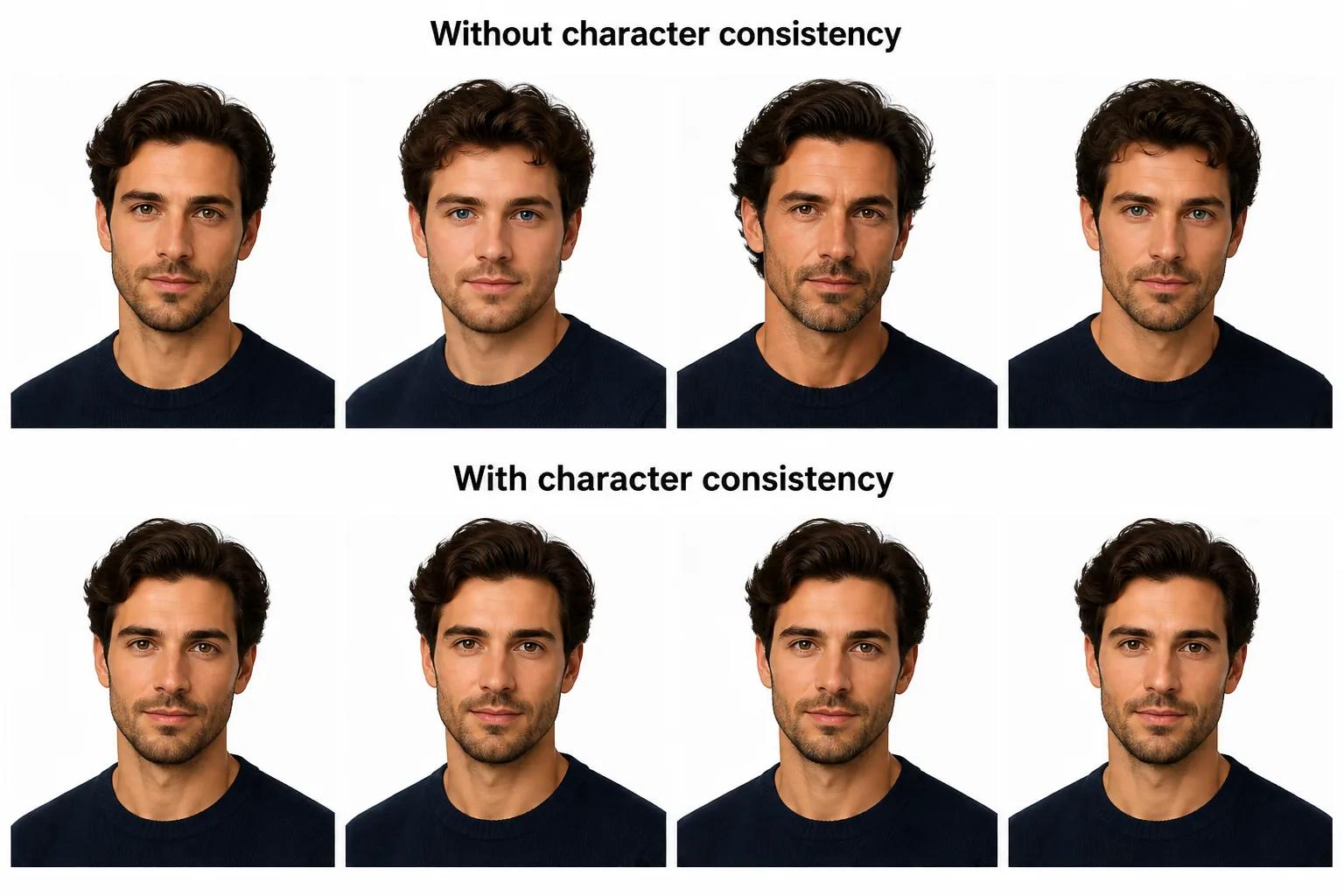
If you've ever generated a scene with AI and watched your main character morph into a slightly different person in the next shot, you already know the problem. AI character consistency is the ability of an AI video tool to keep the same character — same face, hair, body, and wardrobe — looking like the same person across every scene of your film.
It sounds simple. It's actually the single hardest problem in AI filmmaking, and it's the one feature that separates a real AI film from a sequence of cool-looking but disconnected clips. This guide explains what character consistency is, why it's hard, and how filmmakers using tools like Storytella.ai actually solve it.
What Is AI Character Consistency?
AI character consistency is the ability for an AI video generator to render the same character — with the same face, body, hair, and wardrobe — across multiple scenes, shots, and angles, without the character visually drifting from one generation to the next.
In a traditional film, character consistency is automatic: you cast an actor, and that actor looks like themselves in every shot. In AI filmmaking, every scene is generated from scratch, so there's no actor — only a description and a model trying to interpret it. Without character consistency, the same prompt can produce three different people who happen to share a hairstyle.
A platform with strong character consistency lets you define a character once and reuse them throughout your film, the same way a director casts an actor once and uses them throughout production.
Why Does AI Character Consistency Matter for Filmmakers?
Inconsistency breaks the story. The moment your viewer thinks "wait — is that the same person?" they've stopped watching your film and started watching a tech demo.
For filmmakers, character consistency matters for three concrete reasons:
1. Audience trust. A film is a contract with the viewer: this is the world, these are the people in it. When characters morph between scenes, the contract breaks and the emotional connection goes with it.
2. Story continuity. Drama depends on a character changing over time — but the audience has to recognise them well enough to notice the change. If they look like a different person in every scene, you've lost the throughline.
3. Production scale. Without consistency, every new scene is a gamble. With it, you can plan a five-minute film with a clear cast and execute it the same way a real director would — scene by scene, with confidence.
This is why "consistent characters" sits at the top of the feature list for every serious AI filmmaking platform. It's not a nice-to-have; it's the floor.
How Does AI Character Consistency Work?
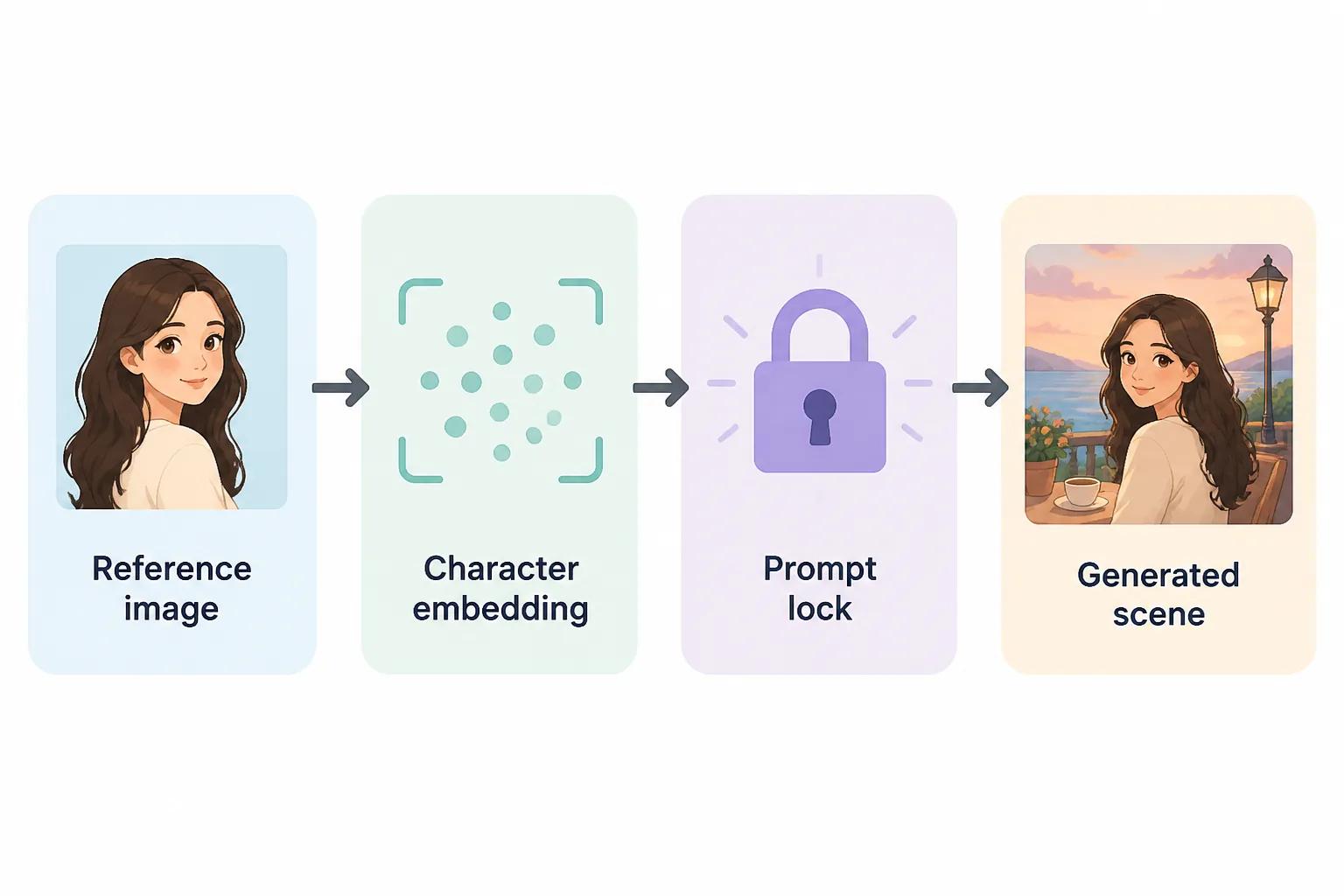
In plain English: the AI is given a fixed reference for what a character looks like, and that reference is fed back into every new generation so the model has something to anchor to.
Different platforms implement this differently, but most use some combination of these techniques:
Reference images. You upload or generate one canonical image of the character. The platform stores it, and every subsequent scene references that image when rendering the character.
Character embeddings. Behind the scenes, the platform converts the character's appearance into a numerical fingerprint (an "embedding") that the model uses to recreate the same identity. You don't see this — you just see a name like "Anna" attached to consistent renders.
Prompt locks. The platform automatically inserts a detailed description of the character into every scene prompt, so the model gets the same instructions every time.
Style + identity separation. Good platforms separate who the character is (identity) from how the scene looks (style and lighting). This lets you put Anna into a noir scene, a sunlit kitchen, or a rainy alley — and she still looks like Anna.
When all four work together, you get something close to "casting" in AI film: you create the character once, and then you use them.
What Breaks AI Character Consistency?
Even on a strong platform, a few things still cause character drift. Knowing them helps you avoid them.
Vague prompts. "A woman in her thirties" gives the model permission to invent a new woman every time. The more specific the character is defined, the less the model improvises.
Conflicting style instructions. If your scene style is "anime" but the character was defined as photorealistic, the model has to pick a side — and it might pick wrong.
Extreme angles and lighting. A character lit from below at 90 degrees is harder for the model to recognise as the same person than a standard three-quarter shot. Strong platforms compensate, but it's still where most drift happens.
Switching tools mid-project. Each AI model has its own way of representing identity. Move a character between tools and you'll usually need to re-lock them.
Letting the model "interpret." Some platforms let the model fill in gaps in your prompt. That's where new noses, new hair colors, and new ages quietly enter your film.
The fix in every case is the same: use a tool that locks the character once, and don't ask it to improvise on identity.
How Do You Keep Characters Consistent Across Scenes?
The practical workflow looks like this:
1. Define the character once, in detail. Name, age, build, face shape, hair, eye color, wardrobe, and any signature details (a scar, a tattoo, a specific jacket). Treat it like a casting call sheet.
2. Lock them in your platform. Use whatever "character" or "cast" feature your tool offers. This is what most platforms now build their workflow around.
3. Reuse the character in every scene. Never re-describe them from scratch. Let the platform handle continuity in the background.
4. Keep style consistent. Decide on a film style (photorealistic, anime, illustrated, etc.) once, and apply it across the project. Mixing styles is the second-biggest cause of drift after vague characters.
5. Review the full sequence, not just single scenes. A character can look fine in isolation and still drift across a five-scene sequence. Always watch the cut, not the clips.
6. Regenerate, don't reshoot. When a scene drifts, regenerate it with the same character lock. That's the AI version of "another take."
Done this way, a single filmmaker can hold a consistent cast across an entire short film without writing prompts from scratch each time.
What to Look for in an AI Filmmaking Platform
Character consistency is the feature you should evaluate first when picking an AI video tool. Specifically:
- Named characters that persist across a project, not one-off prompts you re-type each scene
- A character library you can come back to in future projects
- Style control applied at the project level, so identity and style don't fight
- Scene-by-scene editing that keeps the character locked while you iterate on action, framing, and lighting
- An end-to-end workflow from script to final cut, so you're not stitching together six different tools (each with its own idea of who your character is)
Storytella.ai is built around exactly this workflow — define your characters once, apply a consistent style, and generate every scene of your film with the same cast intact. It's how solo filmmakers and small teams ship full AI films without a crew.
FAQ
What is AI character consistency in simple terms?
It's the ability of an AI video generator to keep the same character — same face, same body, same wardrobe — across multiple scenes of a film, so the character looks like a real, recognisable person from start to finish.
Why is AI character consistency so hard?
Because every scene is generated from scratch. Without a strong identity lock, the AI is essentially re-imagining the character every time, which is why so many AI clips look great in isolation but fall apart as a sequence.
Can AI keep the same face across multiple scenes?
Yes — when the platform uses reference images, character embeddings, and a project-level character lock. Tools built for filmmaking, like Storytella.ai, are designed to handle this automatically.
What's the difference between character consistency and style consistency?
Character consistency is about who the person is (face, body, wardrobe). Style consistency is about how the world looks (lighting, color, film stock, animation style). Both matter, but they're solved separately and good platforms handle them at the same time.
Do I need to upload my own reference photos?
Not always. Many AI filmmaking platforms let you generate a character from a description, then lock that generated version as your reference. You can also upload real photos if you want a specific look — useful for likeness work or recreating a real actor's appearance with permission.
How many characters can I have in one AI film?
There's no hard limit on most platforms. Practically, indie filmmakers usually work with two to six core characters per short film — the same range as traditional indie production.
Will character consistency replace casting real actors?
For some projects, yes — especially solo filmmakers and creators making content where hiring actors isn't realistic. For others, real actors will stay essential. AI character consistency expands what's possible without replacing what already works.
Conclusion
AI character consistency isn't a buzzword. It's the difference between an AI film that holds together and an AI film that falls apart in the second scene. Define your characters once, lock them at the project level, and use a platform that's built to keep them stable across every shot.
The filmmakers shipping real AI films right now aren't the ones with the best prompts. They're the ones using tools that handle identity, style, and continuity for them — so they can spend their time on the part only a human can do: telling the story.
Try Storytella.ai and take your characters from idea to final cut with the same face in every scene.
Your story awaits
The set is ready for you.
Turn your screenplay into stunning storyboards and animatics in minutes — not months. No drawing skills required.
Free to start · No credit card required · Cancel anytime