 Storytella
The Pre-Production Bottleneck: Why Indie Films Stall Before Frame One
Most indie films never reach a camera. The reason isn't budget or talent — it's the quiet, weeks-long stall that happens between "great script" and "first da...
The Pre-Production Bottleneck: Why Indie Films Stall Before Frame One
You have a script you believe in. You have a few people who've said yes. You might even have a small chunk of money. And yet, six months later, you still haven't shot a single frame.
This is the most common story in indie filmmaking, and it almost never gets told. The film didn't fail on set. It failed in indie film pre-production — the long, unglamorous middle stretch where most projects quietly die. This guide breaks down where pre-production actually stalls, why it happens to nearly every solo or small-team filmmaker, and the modern workflow (including tools like Storytella.ai) that's letting independents push through it faster than ever.
Table of Contents
- What pre-production actually covers
- The five bottlenecks that kill indie films
- Why the stall is structural, not personal
- The modern indie pre-production workflow
- Where AI fits into pre-production
- FAQ
- Conclusion
What Pre-Production Actually Covers
Pre-production is everything that happens between "the script is ready" and "we're rolling on day one." For an indie filmmaker, that usually includes:
- Locking the script and breaking it down by scene
- Casting actors and securing their availability
- Scouting and confirming locations
- Building a shot list and storyboards
- Scheduling the shoot around real-world constraints
- Lining up gear, crew, and a budget that survives contact with reality
On a studio film, each of these has a department. On an indie film, all of them have you. That's the structural problem nobody warns you about.
The Five Bottlenecks That Kill Indie Films
Across hundreds of indie post-mortems, the same five bottlenecks show up again and again. Recognise them early and you can route around them.
1. Script Lock (The Quiet Killer)
Indie filmmakers are usually also the writers. That means there's no external force telling you the script is done. You can — and probably will — keep tweaking it indefinitely. Every rewrite resets every downstream decision: casting, locations, scheduling, storyboards.
The fix isn't a perfect script. It's an agreed-upon lock date that you treat as non-negotiable.
2. Casting Without a Schedule
Most indie films cast based on chemistry and budget, then try to schedule around five different actors' day jobs. By week three of trying to find a Saturday that works, half the cast has booked something else.
3. Location Lock-In
You found the perfect coffee shop. The owner said yes verbally. Then the date moves, the owner gets cold feet, and you start over. Locations are the single most fragile dependency in an indie shoot, and the one most often left informal.
4. Visualization Debt
Storyboards and shot lists are the things indie filmmakers skip first because they feel "optional." They aren't. Without them, every conversation with a DP, actor, or editor starts from zero. Decisions get made on set, under pressure, and the film loses coherence.
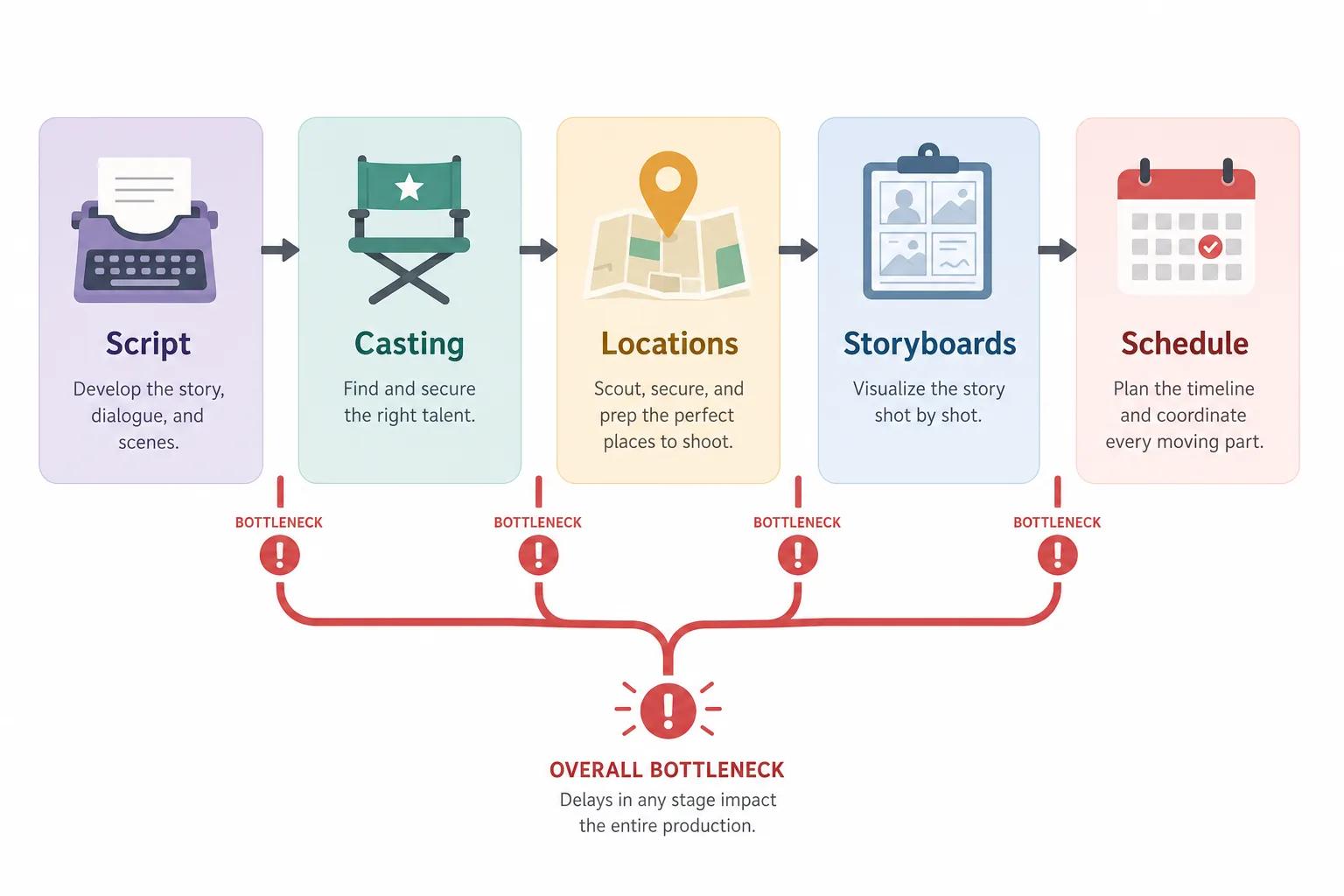
5. The Scheduling Spiral
Once any one of the above slips, the schedule slips. Once the schedule slips, actors and locations re-open. Once those re-open, the budget slips. Pre-production isn't five problems — it's one problem with five entry points.
Why the Stall Is Structural, Not Personal
Most indie filmmakers blame themselves for the stall. They shouldn't. Pre-production is built around assumptions that no longer match how independent films actually get made.
The traditional model assumes:
- A producer who manages dependencies full-time
- An assistant director who builds and protects the schedule
- A casting director with relationships and reach
- A production designer pre-visualizing the world
A solo or two-person indie team has to be all of those people while also writing, directing, and often acting. The stall isn't a failure of will. It's a failure of bandwidth.
This is why the conversation around indie film pre-production has shifted in the last two years — from "work harder" to "use tools that compress the work."
The Modern Indie Pre-Production Workflow
The indie filmmakers who are actually finishing films in 2026 are running a tighter, more tool-driven workflow. It looks roughly like this:
| Stage | Old Approach | Modern Approach |
|---|---|---|
| Script lock | Endless rewrites | Hard lock date + version control |
| Visualization | Hand-drawn or skipped | AI-generated storyboards and scene previews |
| Casting | Open calls + chemistry reads | Targeted outreach with visualized scenes |
| Location | Verbal handshakes | Written agreements + backup options |
| Scheduling | Spreadsheets that break | Dependency-aware scheduling tools |
| Pre-visualization | Optional | Mandatory before any shoot |
Notice the pattern: every modern shift moves a decision earlier in the timeline and makes it visible to everyone involved. That's the actual fix to the bottleneck — not more hours, but more clarity at each stage.
Where AI Fits Into Pre-Production
The biggest change in indie filmmaking over the last 18 months is that pre-visualization, scene generation, and even rough scene assembly no longer require a full team. AI filmmaking platforms have collapsed weeks of work into hours.
Storytella.ai is built around this exact problem. Instead of separately handling script breakdown, character design, scene visualization, and rough cut assembly, you do all of it in one workflow. You can:
- Visualize every scene in your script before casting anyone
- Maintain character consistency across scenes so investors and collaborators can see the film clearly
- Apply a unified visual style across the production so the look is decided early, not in post
- Iterate scenes by regenerating instead of reshooting
The key shift here isn't replacing the human work of writing and directing. It's removing the parts of pre-production that historically required a department you don't have.
[INTERNAL LINK: relevant Storytella article on character consistency in AI filmmaking — confirm URL]
A Practical Pre-Production Checklist
If you want a single page to tape above your desk, this is it.
- Script is locked with a written date — no rewrites past this point
- Each scene is broken down: location, characters, props, time of day
- Every scene has been visualized at least roughly
- Each location has a written confirmation and a backup
- Each cast member has confirmed availability for specific dates
- The schedule has been stress-tested against one actor pulling out
- The budget includes a 20% contingency line
- The DP, sound, and editor have all seen the visualized scenes
- You know what the first three days on set look like, hour by hour
If any box is unchecked, the bottleneck isn't gone — it's just hiding.
FAQ
How long should indie film pre-production take?
For a short film, 6–10 weeks is realistic. For a feature, 3–6 months is typical for a well-resourced indie. If you're past those marks without movement, the bottleneck has set in — usually at script or scheduling.
What's the most overlooked stage of pre-production?
Pre-visualization. Indie filmmakers consistently skip storyboards and shot lists, then pay for it on set with wasted hours and incoherent footage. Visualizing scenes early is the cheapest insurance you can buy.
Can AI replace pre-production?
No — it replaces the parts of pre-production that previously required a team. The creative decisions (story, performance, visual language) still belong to the filmmaker. Tools like Storytella speed up the executional layer so the creative layer has room to breathe.
What's the cheapest way to break the pre-production bottleneck?
Lock the script, write down every dependency on one page, and pre-visualize every scene before you cast. The first two cost nothing. The third used to cost a storyboard artist; now it doesn't.
How do I keep cast and crew engaged during a long pre-production?
Show them the film. Not a pitch deck — actual visualized scenes. Pre-visualization keeps people emotionally invested when calendars start to drift, which is the moment most indie projects lose people.
Do I need pre-production if I'm shooting on a phone with one actor?
Yes — just less of it. The structure (script lock, location, schedule, visualization) still applies. You can compress it to a weekend, but skipping it almost guarantees re-shoots.
Where does Storytella fit into a traditional indie workflow?
Storytella.ai sits in the visualization, scene-development, and rough-cut layers. Many filmmakers use it to pitch the film, lock the visual style, and even generate full scenes that complement live-action footage.
Conclusion
The reason most indie films stall before frame one isn't a lack of passion or talent. It's that pre-production is a five-headed problem being handled by one person, with tools designed for a team that doesn't exist anymore.
The fix isn't heroic effort. It's structural: lock the script, visualize early, write everything down, and use modern tools to compress the executional work so you can spend your bandwidth where it actually matters — on the film itself. Indie filmmaking has never been more achievable for solo creators, but only if you treat pre-production as the part of the process that wins or loses the film.
Try Storytella.ai and take your script from idea to fully visualized scenes — without a crew, a studio, or a six-month pre-production stall.
Your story awaits
The set is ready for you.
Turn your screenplay into stunning storyboards and animatics in minutes — not months. No drawing skills required.
Free to start · No credit card required · Cancel anytime